Web agency CRM and business software
RegiaPro is business software for web agencies and design studios that sell websites, logos and campaigns on commission: the CRM follows everyone who asks for a quote, the business side keeps contracts, deposits and invoices. “Web agency” is already selected: keep on only the parts you’ll use.


Built for more than 50 trades: this one is already set up for yours

Engagement accepted
documents and deadlines in one record
Today in RegiaPro
Example with made-up data
9
Active engagements
+2 this month
4
Deadlines
this week
€5,800
To be collected
3 fee notes open
Engagement accepted by the client
8 min ago
Fee note sent
yesterday
Case deadline on Friday
yesterday
- Free for 14 days, no card needed
- Works in the browser, on your phone too
- Calendar synced with Google and iCloud
- WhatsApp messages already written
- Invoices from your Fatture in Cloud, from the Pro plan
- Public prices, the same for everyone
Type of work
What do you do? If you can’t find yours, the last option is just fine.
What do you need? The basics for web agency CRM and business software are switched on. Turn on what you really need: we pick the plan from here.
Your RegiaPro is ready.
Tap a plan: below you see what is inside.
There is only one price list. Photo galleries come with every plan: if you don't deliver photos you simply don't open them, and the price stays the same. Compare all the plans
What you get with
The menu
An enquiry record
The fields of your trade are highlighted
The stages of the job
Where every job stands, at a glance
If you build websites and design for clients, you work on projects that last weeks. The enquiry comes in through your site’s contact form, the quote changes twice, the contract sets how many revisions are included, part is paid when you start and the rest when the site goes live. RegiaPro, the web agency business software, gathers every step on the client record, which you open from the office computer or from your smartphone; the basic plan costs €19.90 a month.

What you’ll find inside RegiaPro: from enquiry to invoice
One program for clients, proposals, engagements and invoices. Tap a card to see how it works.
-
One record per client
Calls, quotes, contracts and payments in date order: when they call back six months later, you know at once where you left off.
The Lead module -
Who to call back today
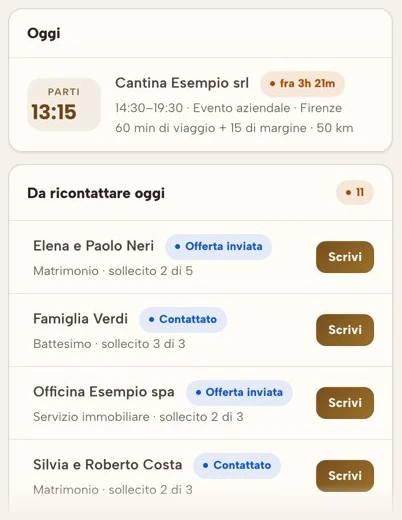
Every morning, the list of people to get back to, with the WhatsApp message already written. It goes from your own number, when you decide.
Follow-ups and messages -
Quotes from your own template
The PDF with your logo, sent as a link: you know when it was opened. If there is no reply, the program brings it back to you after 3, 7, 14 and 30 days.
The quote -
The contract without retyping
It comes from the accepted quote, with the details already in, and comes out as a PDF ready to sign. From the Pro plan.
Which plans include it -
The site visit
It is a stage of the job, with its own date; the travel cost is worked out on the real route.
The costs of each job -
Consulting on a retainer
The draft invoice for each period gets ready on its own. From the Pro plan.
Fees and renewals -
Deposit, balance and invoice
Deposit and balance are recorded separately, each with its own date. The invoice comes out of the record with numbering that carries on by itself: from the Pro plan, with the XML file from the Studio plan.
The plans compared -
The calendar you already have
Appointments and jobs in your phone’s calendar: RegiaPro connects to Google Calendar and iCloud.
The connected calendar -
What is really left
A job’s costs come off that job, the business costs off the year: in December you know what is left, not just what came in.
The figures of each job -
From your phone, on site
It works in your phone’s browser: open the client’s record and attach photos and documents, up to 15 MB each.
How it works
RegiaPro up close: the real screens
This is what the program looks like inside. Sample data: the clients, the jobs and the amounts are made up.
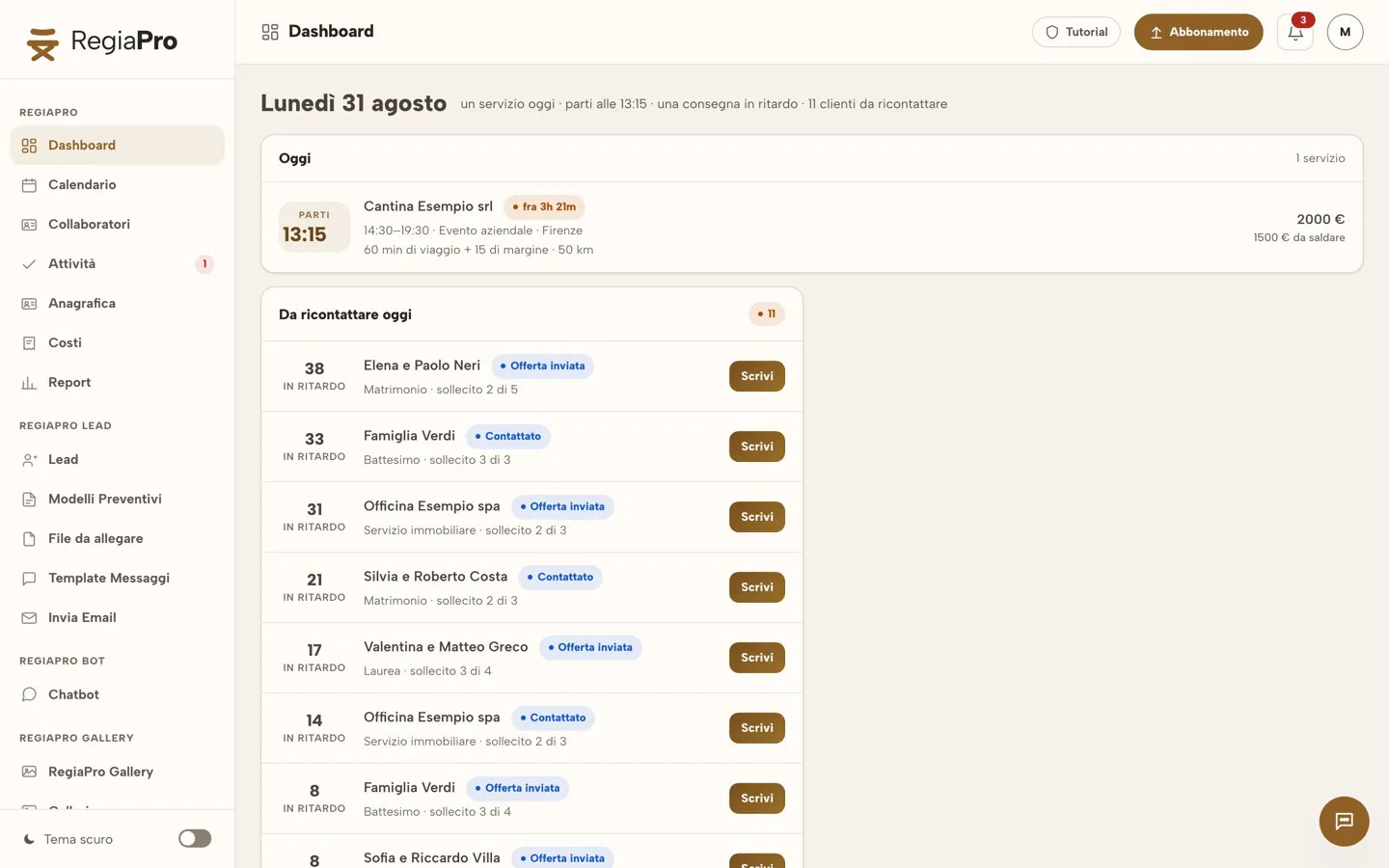
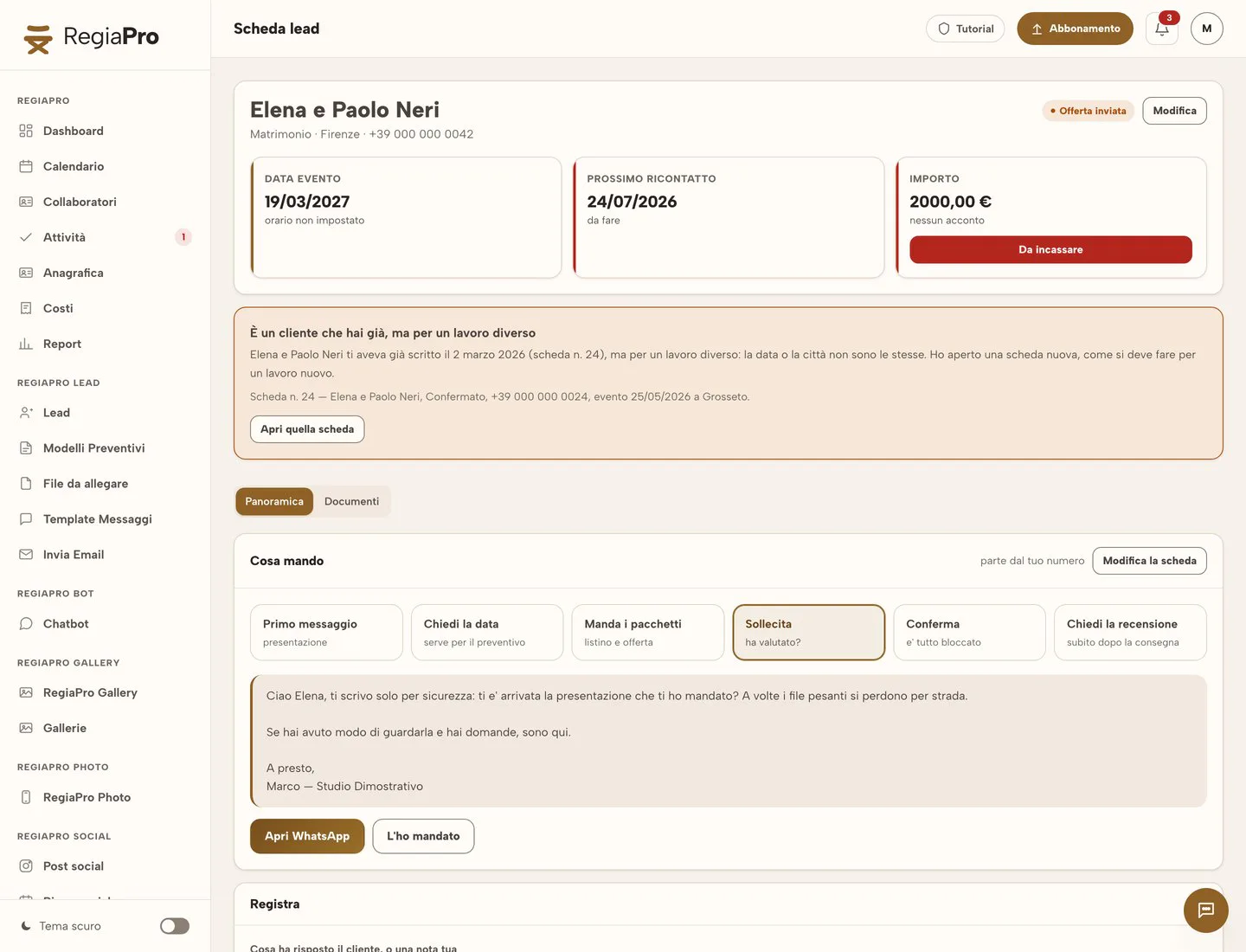
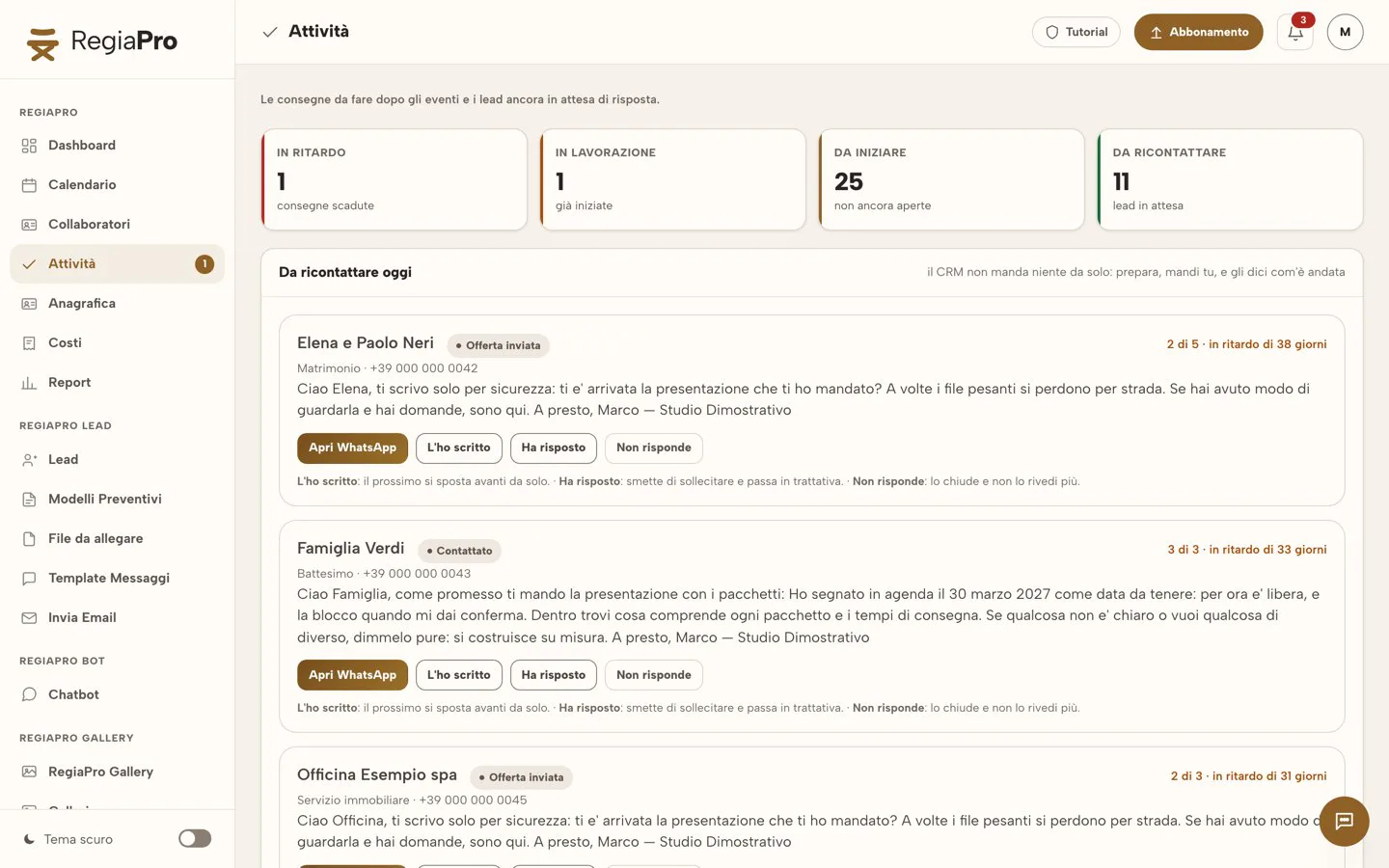
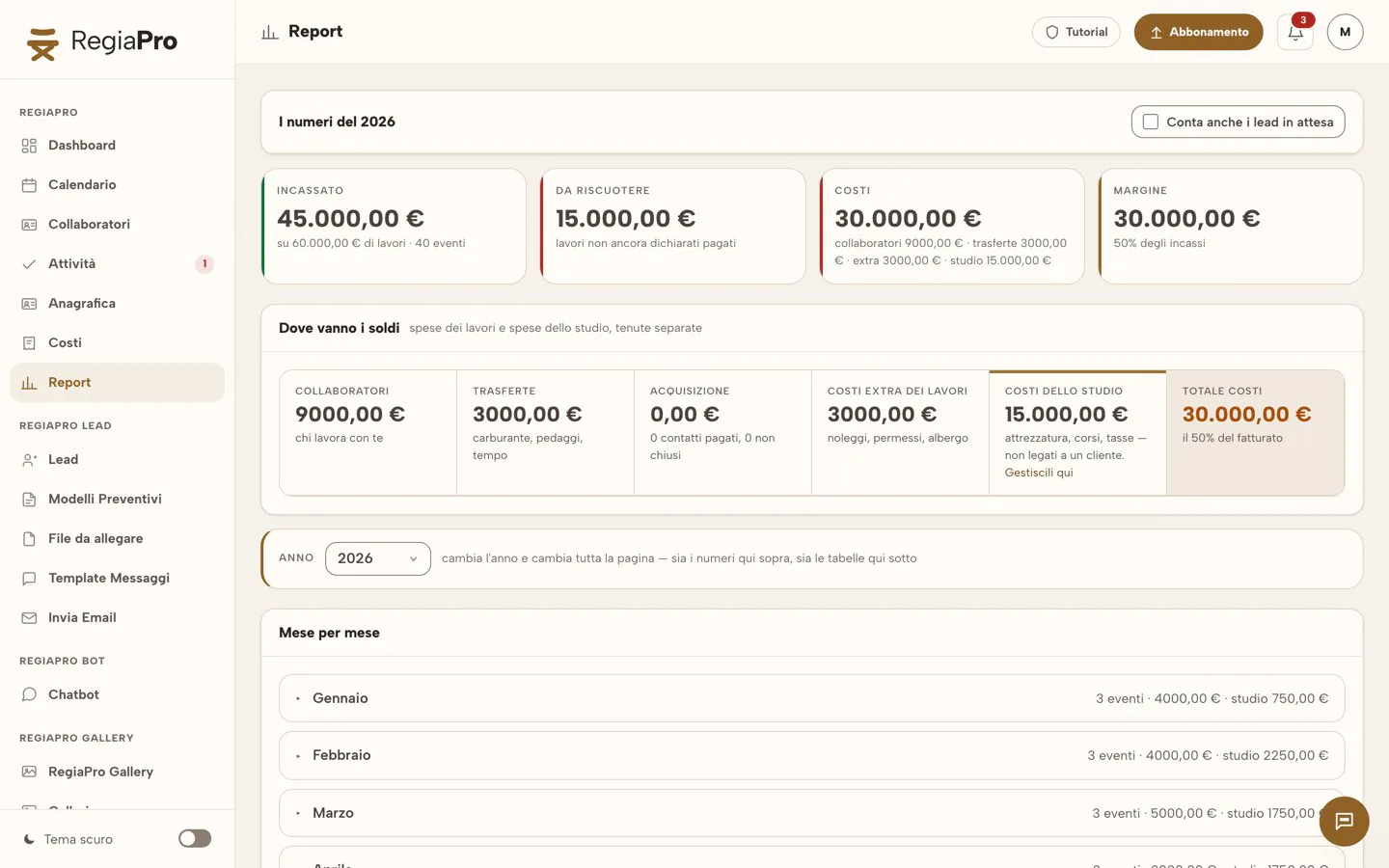
Web agency and design studio software: which agencies it’s built for
RegiaPro is for small agencies and web freelancers, where the person who sells the project is often the one who sees it through to delivery. It also works as business software for small communications agencies juggling campaigns, print and websites. These are the jobs it handles best.
Brochure sites and online shops for the agency’s clients
A brief to gather, a price to discuss, an agreed go-live date and a payment that arrives in two stages.
Logos and brand identity for the design studio
Proposals, variations and a final choice: short jobs where it pays to put in writing how many proposals the price includes.
Agency campaigns and print-ready artwork
Catalogues, flyers, trade fair graphics: they have a hard deadline and often an outside supplier, the printer, to pay separately.
Redesigns of websites already delivered
A new section, a redesign, an update: the client gets back in touch months later, and finding their history saves you digging through your inbox.
Where a web agency loses time
The creative and technical side is the craft the agency knows. The time goes elsewhere: working out which version of the quote the client saw, remembering who is waiting for a reply, figuring out how much is still to be paid on a project closed in July. The business side keeps documents and payments; the CRM keeps people, enquiries and follow-ups.
The agency’s first ten minutes on RegiaPro
Start with the projects you already have under way: one record for each client waiting for a website or a design, with the agreed date and any deposit received. From there the home page shows you who to follow up today and the calendar shows you the month’s deliveries.
Web agency CRM: your agency’s clients from first message to signature
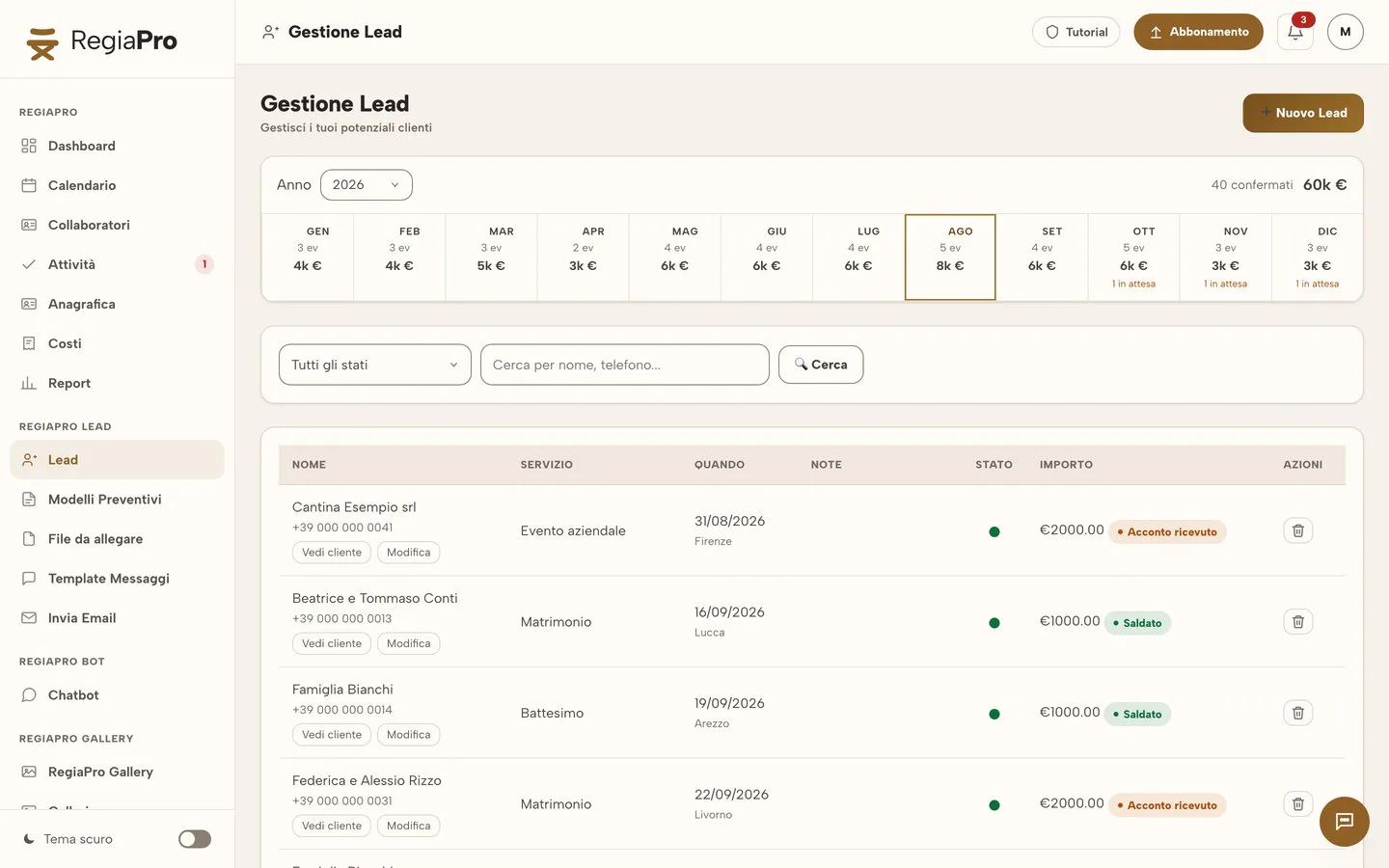
In RegiaPro’s CRM, people come before documents. Here are six moments when an agency risks losing a client or a piece of their history, and how you keep them under control.
Website enquiries from forms, LinkedIn and word of mouth
Your site’s form, an email forwarded by your business partner, a LinkedIn message, a happy client passing on your number.
In RegiaPro every enquiry becomes a record with its source, and you write the list of sources yourself in Settings.
The website brief scattered across emails
Goals, pages to build, sites the client likes and the old logo end up in three different conversations.
In RegiaPro the brief goes in the record’s notes and the files you receive stay attached: Word or PDF documents and JPG or PNG images, up to 15 MB each.
The business owner who keeps putting off the website quote
Someone who receives a three-thousand-euro quote rarely says no: more often they put it off, and then forget about it.
In RegiaPro that owner reappears in the “Follow up today” box on the home page three days after sending, and again on the seventh, fourteenth and thirtieth day; when you log their reply, the follow-ups stop.
Website revisions: nobody remembers what was included
Two rounds of revisions or three? Was the blog part of the price or an extra?
In RegiaPro the record’s log keeps, in date order, the emails with the attached PDF, the WhatsApp messages and the notes written after a phone call.
The website launch slips
Copy delivered late, a domain to transfer, a supplier slow to reply.
In RegiaPro the confirmed project sits on the calendar with its date; if you move it from your phone, a few minutes later it changes on the record too.
Agency clients who come back for website maintenance
A page to add or an update a year later, and nobody remembers the figure quoted last time.
In RegiaPro you search by name or phone and find past projects with their documents; you reconnect the company’s billing details to the new record with one click.
Website build quote: a project followed step by step
This is a project followed from start to finish inside RegiaPro. People, days and amounts are invented, while every step matches a real command in the software.
-
The project: a website for a farm stay
On 2 September Chiara, who runs a farm stay with six rooms, asks for a new website in Italian and English, with a page for each room and a form for booking enquiries. She wants to be online on 20 November, before holiday bookings start. It’s a typical job for a small web agency: an owner who decides alone, a budget to work out, a date tied to the season.
Try it for 14 days -
The farm stay record: brief, files and go-live date
Chiara fills in the contact form on the agency’s site; you open her record with name, phone, email and source “website”, and paste her message into the notes. After the first phone call you complete the brief: eight pages, two languages, enquiry form, new photos of the rooms, domain already registered in her name. The record has a single date, and for an agency it’s handy to use it for the go-live: here, 20 November. You attach the logo as a PDF and the room price list.
Follow-ups and messages -
One price for the website, with design and development items in the note
On 7 September you agree on €3,200 plus VAT. On the record the amount is entered as the total the client pays, so €3,904: RegiaPro separates out the tax and the PDF shows the net amount and VAT. The quote goes out with the agency’s logo, the text of your template and one price line; you list the items in the note, printed at the bottom of the document: design of eight pages, development with an area for updating content, English version, enquiry form, basic SEO setup, two rounds of revisions, one hour of training. It goes out by email straight from the record, and in the client list Chiara immediately shows as “Quote sent”.
The quote from your template -
The Italian-only website: the reduced version without losing the first
On 12 September Chiara asks how much it would cost to start in Italian only. You change the amount to €3,172, that is €2,600 plus VAT, and from the same record you generate another proposal, which you send her straight away: it gets number 42/2026-P, and 41/2026-P from five days earlier doesn’t change by a cent.
The quote from your template -
Chiara’s website build contract
On 16 September Chiara chooses the version with English. You set the amount back to €3,904 and, from the Pro plan, generate the contract from your template: you decide the title, for example “Website build contract”, and the terms are the agency’s own. RegiaPro fills the client’s name, the company name of whoever pays, the go-live date and the three figures (total, deposit, balance) into the placeholders. You sign the paper copy at the agency; if Chiara prefers to send it back signed by email, you attach the scan to the record.
The contract, from the Pro plan -
The farm stay deposit and the go-live on the calendar
On 19 September a bank transfer of €1,500 arrives: you log it on the record as a deposit, with the date and bank transfer as the payment method, and move the project to “Confirmed”. From then on 20 November also appears on Google Calendar or iCloud, if you’ve connected them. In the important note you write “connect the domain and test the English form”: it becomes a reminder you find among your tasks on 13 November, seven days before the date.
Invoices and payments in the plans -
Room photographer and licence: who works on the site and what it costs
The room photos are taken by an outside photographer for €350: you add them as a collaborator on the record. Under extra costs you put €89 for the booking form licence, noting what it’s for.
The figures of each job -
Website live, balance and the agency’s invoice
On 14 November the site is ready to view: from the record you open WhatsApp with the message prepared among your templates, add the preview link and press send yourself. On 20 November the site goes live. Chiara pays the remaining €2,404 in two instalments, on 20 November and 20 December, and after each payment the record updates the balance due. The invoice, from the Pro plan, is created from the record on the full project amount and takes the next number of the year.
Invoices and payments in the plans
The farm stay website figures
Total €3,904 including VAT: €1,500 deposit and two instalments of €1,202. After the photographer and the licence, €3,465 is left, with VAT and taxes still included; in the Report those costs come out of the margin for November and for the year. Documents produced: two quotes, one contract, one invoice.
Chiara’s project in a table (example with invented data)
| Date | What happens with the client | What you record in RegiaPro |
|---|---|---|
| 2 September | Enquiry from the website form | Record opened, brief in the notes, go-live on 20 November |
| 7 September | Agreement on €3,200 plus VAT | Quote 41/2026-P with the items in the note, status “Quote sent” |
| 12 September | Asks for the Italian-only version | Quote 42/2026-P for €3,172 |
| 16 September | Chooses the two-language version | Website build contract as a PDF |
| 19 September | €1,500 deposit | Deposit logged, project confirmed and on the calendar |
| 13 November | Final checks before launch | Reminder created from the important note |
| 20 November | Site live and first instalment of €1,202 | Instalment logged and project invoice |
| 20 December | Second instalment of €1,202 | Balance paid in full |
Logo and design quote: the design studio in the CRM
A logo or a catalogue is wrapped up in a few weeks, but it raises the same questions as a website: how many proposals, when you get paid, what gets delivered. Here’s how a design studio handles them.
How many logo proposals are included
In the quote note you write the number of initial drafts and tweaks included, for example three proposals and two rounds of changes on the chosen one. It’s the sentence you’ll find printed when the sixth change request arrives.
The catalogue with the printer
The agency pays the printing cost and passes it on in the price: on the record you log it under extra costs with the label “print 500 copies”, so the margin the Report shows for that month is the real one.
Delivering the final brand
When the client approves, you open “Send email”, choose their name and attach the final PDF of the brand or catalogue, up to 15 MB. A copy of what you sent ends up in the log on their record, with date and time.
Website build contract: what to put in it
The contract is the document that gets agency and client to agree before the first draft. In RegiaPro you prepare the base text once, on the Templates page, and for every project the record’s details take the place of the placeholders.
Website pages, languages and features
Number of pages, languages, features such as the form or the shop, who supplies copy and photos and by when.
Website revision rounds and extra requests
How many rounds of changes are included and how further ones are priced.
Go-live date, copy and photos
The go-live date comes from the record; next to it you write that it moves if copy and photos arrive late.
Website deposit and balance in the contract
The placeholders write the total, deposit and balance: the signed document carries the same figures you will later log as paid.
Domain, logins and website source files
Who the domain stays registered to, who keeps the passwords, when the source files pass to the client.
Contracts are generated from the Pro plan up. If you tweak the template in March, contracts signed in January stay exactly the same: every document produced keeps its own text.
Want to see it with your own work?
Fourteen days with the Full plan features, no card needed. Then you decide.


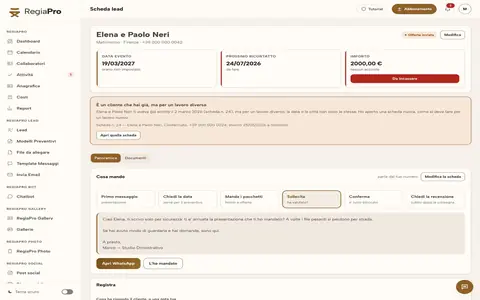
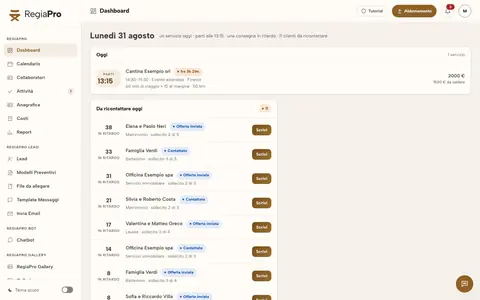



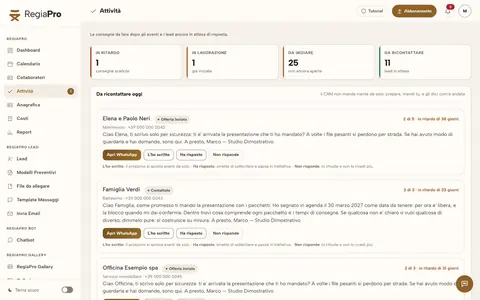

Free photos from Pexels and real screenshots of the software, with made-up data.
Web agency price list: payments, margins and invoices in your business software
Your price list decides what you charge; the business software tells you what’s left. RegiaPro keeps the money on each project’s record and adds it up by month and by year.
Deposit at the start of the website, balance split into instalments
For each project you note the deposit received, when and how it was paid, and a balance you can split into several instalments. On the record and in the total for all jobs you see how much is still to come in.
The marketing manager writes, the company pays
You talk to the marketing manager, the invoice goes to the company. The payer’s details, with VAT number, SDI code or PEC, sit in a separate billing profile that you reconnect when the same company comes back with another job.
The web agency’s invoices, from the Pro plan
They are created from the record on the agreed amount, as a PDF with the agency’s logo, with numbering that restarts from 1 in January. Choose Studio and you also get the e-invoice XML, ready to upload to the SdI, and, once the year is closed, the invoice archive for your accountant.
The Report and the campaigns that bring clients to the agency
You can give each source a cost per contact, for example that of a paid campaign. The Report adds up payments received, collaborators and out-of-pocket costs for confirmed projects and shows, source by source, where the clients who sign come from and how much the contacts cost.
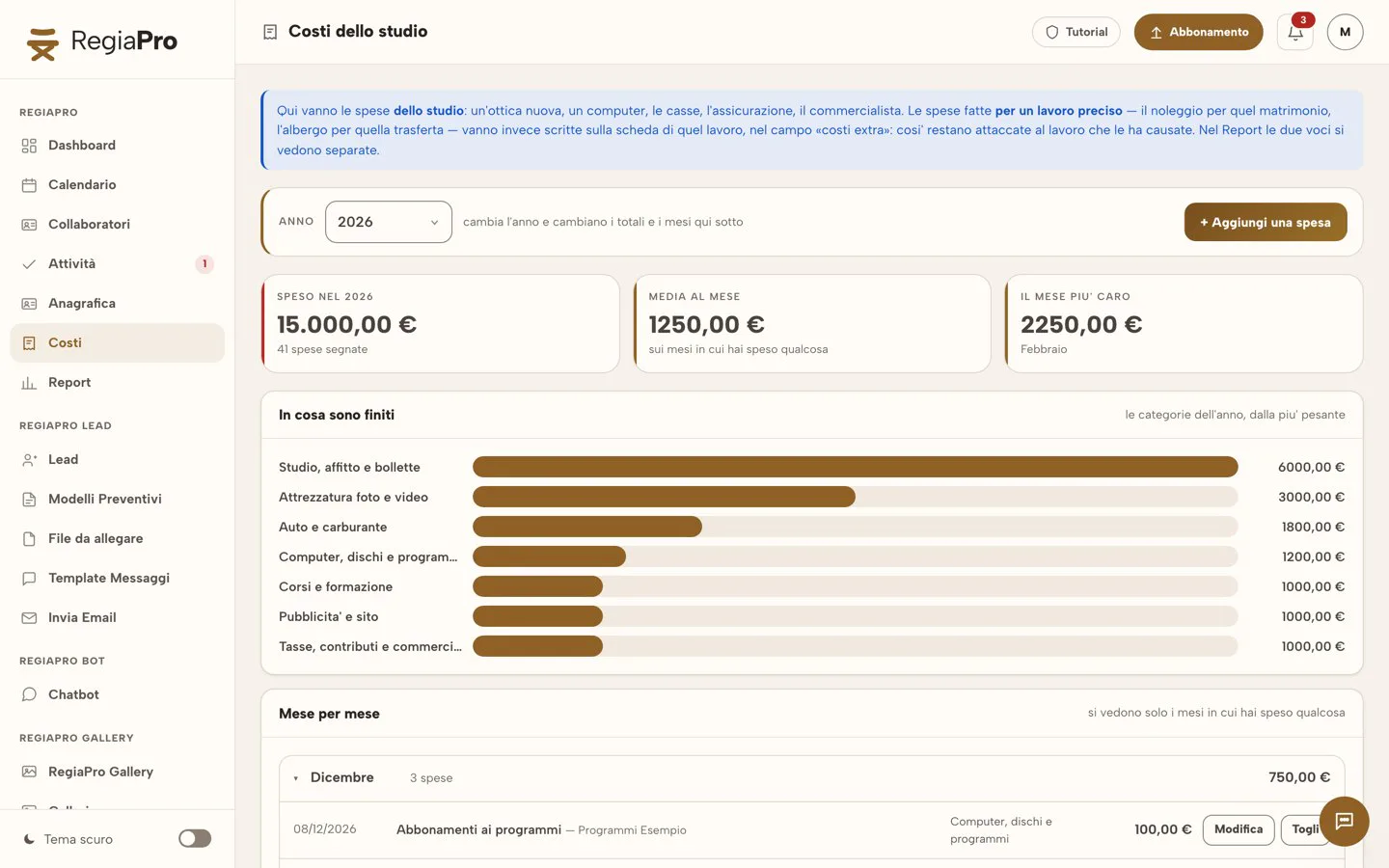
The screenshot comes from the software, filled with test figures: this is where subscriptions, computers and rent go. Costs tied to a single project, for example a licence, are logged on that project’s record.
Software for web agencies: business software, project management or CRM?
If you’re looking for software for your agency, you’ll find different products that go by the same name. Among the top search results, in mid-September 2026, we opened the pages of three agency software products: only one shows its prices, and none mentions the word deposit.
| Platforms for agencies with teams | Admin software for agencies | RegiaPro, business software and CRM | |
|---|---|---|---|
| Who it's for | Agencies with a team to coordinate across many projects | Agencies that want projects and documents in one archive | Small agencies and freelancers selling projects on commission |
| What it handles | Tasks, hours worked, resources, client portal | Projects, quotes, contracts, invoices | Enquiries, follow-ups, quotes, contracts, deposits, delivery dates, invoices |
| Price | Not stated on the pages we read | Shown on the page | From €19.90 a month, published |
| How to try it | Demo or 30-day trial | 30-day trial | 14 days with the Full plan switched on |
RegiaPro is right for your web agency if
- you sell projects to clients who decide quickly and pay in two stages;
- you need to remember who is waiting for a reply and which proposal they received;
- you want to know the cost before talking to a salesperson.
What a web agency finds on day one
- client records with source, brief in the notes and attached files;
- numbered proposals as PDFs; contracts and invoices come with Pro;
- deposit and instalments, connected calendar, a log for every client and ready-made WhatsApp messages.
How to start: three steps, no card needed
You sign up, try it on your real work, and only decide at the end.
-
Sign up in a minute
Your name, your business name and your email. We don’t ask for a credit card: access starts when you confirm your email.
Start the trial -
Set it up for your trade
Menus, record fields and job stages speak your language. You connect the calendar you already use.
Choose your trade here -
Try everything, then choose
Fourteen days with the Full features. At the end you choose a plan, or you stop: nothing renews on its own.
See the plans
How much RegiaPro web agency software costs
Prices are published and they are what you pay. An agency that sells projects needs one of these three plans, after the free trial.
Start for the agency that builds a few sites: €19.90 a month
Paid annually it comes down to €199. It includes unlimited records, follow-up reminders, WhatsApp templates and ten quotes a month: suited to those who deliver a few websites a year.
Pro for those closing web projects every month: €34.90 a month
Or €349 a year. It adds build contracts, numbered invoices and unlimited quotes for the agency.
Studio for the agency with e-invoicing: €59.90 a month
€599 a year. It adds the XML e-invoice and the year-end package for whoever keeps the books.
Two weeks’ trial on the agency’s websites
For fourteen days the agency uses the complete Full plan without entering any card. Access opens by itself as soon as you confirm your email.
If you deliver a lot of video to clients, take a look at Full too, €44.90 a month.
Why you can trust it: your data stays yours
What matters before you put your clients into a new program.
Your data stays in Europe
On servers in Europe. Each business sees only its own data: the database itself enforces the separation.
If you stop, your data stays yours
The account goes read-only and nothing is deleted unless you ask. We send you a copy in a readable format.
Prices written up front
A public price list, the same for every trade: you can read it on the pricing page before you sign up.
You talk to a person
Born in a studio in Tuscany, not in an office. Write to info@regiapro.it or use the contact page.
Web agency software: frequently asked questions
How do I list the items of a website in the quote?
The total goes in the amount field on the record; pages, languages, features, included revisions and training go in the quote note. The note is printed on the PDF below the price, so the client reads what the figure covers.
How do I put the included revision rounds in writing?
Twice: in the quote note, so the client reads it before accepting, and in the contract template, among your terms. The generated contract stays the same even if you later change the template, so the signed version always stands.
I deal with a contact person but the invoice goes to the company: how do I do it?
The record carries the name and phone number of the person running the project. You link the company’s tax details, with VAT number and SDI code or PEC, as the billing party: they end up on the contract and the invoice, and you reuse them on the next project.
How do I keep track of the deposit and instalments up to the website launch?
You note the deposit on the record with date and method, and the balance too, even in instalments. At a glance you see what’s left on a single project and across all open jobs. From the Pro plan the project invoice is prepared on the agreed amount, with the next number.
How do I quickly log enquiries coming from the website form?
Open a new record with name, phone, email and source “website”: it takes a few seconds. You paste the message text into the notes and upload the files the client sends you to the record, so the website brief starts off complete.
Where do I log the outside copywriter or a licence bought for a project?
On the project record: the copywriter as a collaborator, with what you paid them, and the licence under extra costs, noting what it was for. The Report takes these items off the payments received, so the month’s margin is the real one.
Can I see which channels bring the clients who sign?
Yes. Every record has a source, and you can give each one a cost per contact. The Report splits payments and costs by source: you see whether word of mouth, the paid campaign or the portfolio you published online pays off more.
Can I use it from my phone during a meeting at the client’s?
Yes, RegiaPro works in the browser on computer and phone. If you connect Google Calendar or iCloud, you also see confirmed launches in your phone’s calendar, and a date moved there flows back into RegiaPro.
Last reviewed: 14 September 2026; before mentioning a feature we opened it in RegiaPro and used it. Chiara, her farm stay and all the figures are invented; the comparison table comes from the vendors’ websites visited the same day. Noticed a difference from the RegiaPro you use? Let us know at info@regiapro.it: we’ll correct this page.
Try RegiaPro on a client’s next website
Pick the next client who asks you for a website and follow them inside RegiaPro through to the final payment: in two weeks you’ll know whether the software fits the way your agency works. During the trial Full is complete; at the end you choose the right plan for the agency.
Other trades that work by project: social media manager quotes, software for freelance developers, software for interior designers. You’ll find the other trades listed on the Who it’s for page.