Freelance developer CRM and business software
RegiaPro is business software for freelance developers and small software houses that write code to commission: the CRM holds your clients and their enquiries, the business side holds estimates, development contracts, instalments and invoices. The “Developer” trade is already set up; you switch features on one at a time.


Built for more than 50 trades: this one is already set up for yours

Engagement accepted
documents and deadlines in one record
Today in RegiaPro
Example with made-up data
9
Active engagements
+2 this month
4
Deadlines
this week
€5,800
To be collected
3 fee notes open
Engagement accepted by the client
8 min ago
Fee note sent
yesterday
Case deadline on Friday
yesterday
- Free for 14 days, no card needed
- Works in the browser, on your phone too
- Calendar synced with Google and iCloud
- WhatsApp messages already written
- Invoices from your Fatture in Cloud, from the Pro plan
- Public prices, the same for everyone
Type of work
What do you do? If you can’t find yours, the last option is just fine.
What do you need? The basics for freelance developer CRM and business software are already on. Switch on what you really need: we pick the plan from here.
Your RegiaPro is ready.
Tap a plan: below you see what is inside.
There is only one price list. Photo galleries come with every plan: if you don't deliver photos you simply don't open them, and the price stays the same. Compare all the plans
What you get with
The menu
An enquiry record
The fields of your trade are highlighted
The stages of the job
Where every job stands, at a glance
A custom app or piece of software goes through a discovery call, an analysis, an estimate the client tries to bring down, a release that slips and acceptance testing. The code lives in your repository; the people, the commitments made and the payments live in RegiaPro, the business software for freelance developers, open on your laptop or phone, with plans from €19.90 a month.

What you’ll find inside RegiaPro: from enquiry to invoice
One program for clients, proposals, engagements and invoices. Tap a card to see how it works.
-
One record per client
Calls, quotes, contracts and payments in date order: when they call back six months later, you know at once where you left off.
The Lead module -
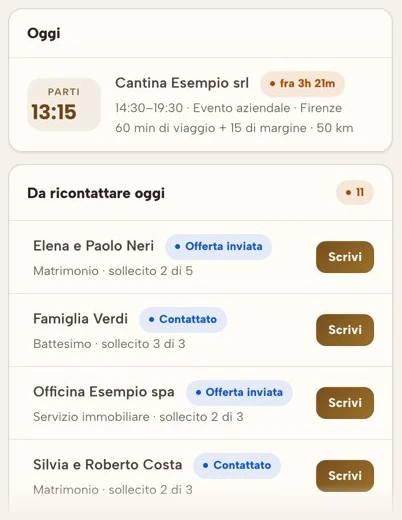
Who to call back today
Every morning, the list of people to get back to, with the WhatsApp message already written. It goes from your own number, when you decide.
Follow-ups and messages -
Quotes from your own template
The PDF with your logo, sent as a link: you know when it was opened. If there is no reply, the program brings it back to you after 3, 7, 14 and 30 days.
The quote -
The contract without retyping
It comes from the accepted quote, with the details already in, and comes out as a PDF ready to sign. From the Pro plan.
Which plans include it -
The site visit
It is a stage of the job, with its own date; the travel cost is worked out on the real route.
The costs of each job -
Consulting on a retainer
The draft invoice for each period gets ready on its own. From the Pro plan.
Fees and renewals -
Deposit, balance and invoice
Deposit and balance are recorded separately, each with its own date. The invoice comes out of the record with numbering that carries on by itself: from the Pro plan, with the XML file from the Studio plan.
The plans compared -
The calendar you already have
Appointments and jobs in your phone’s calendar: RegiaPro connects to Google Calendar and iCloud.
The connected calendar -
What is really left
A job’s costs come off that job, the business costs off the year: in December you know what is left, not just what came in.
The figures of each job -
From your phone, on site
It works in your phone’s browser: open the client’s record and attach photos and documents, up to 15 MB each.
How it works
RegiaPro up close: the real screens
This is what the program looks like inside. Sample data: the clients, the jobs and the amounts are made up.
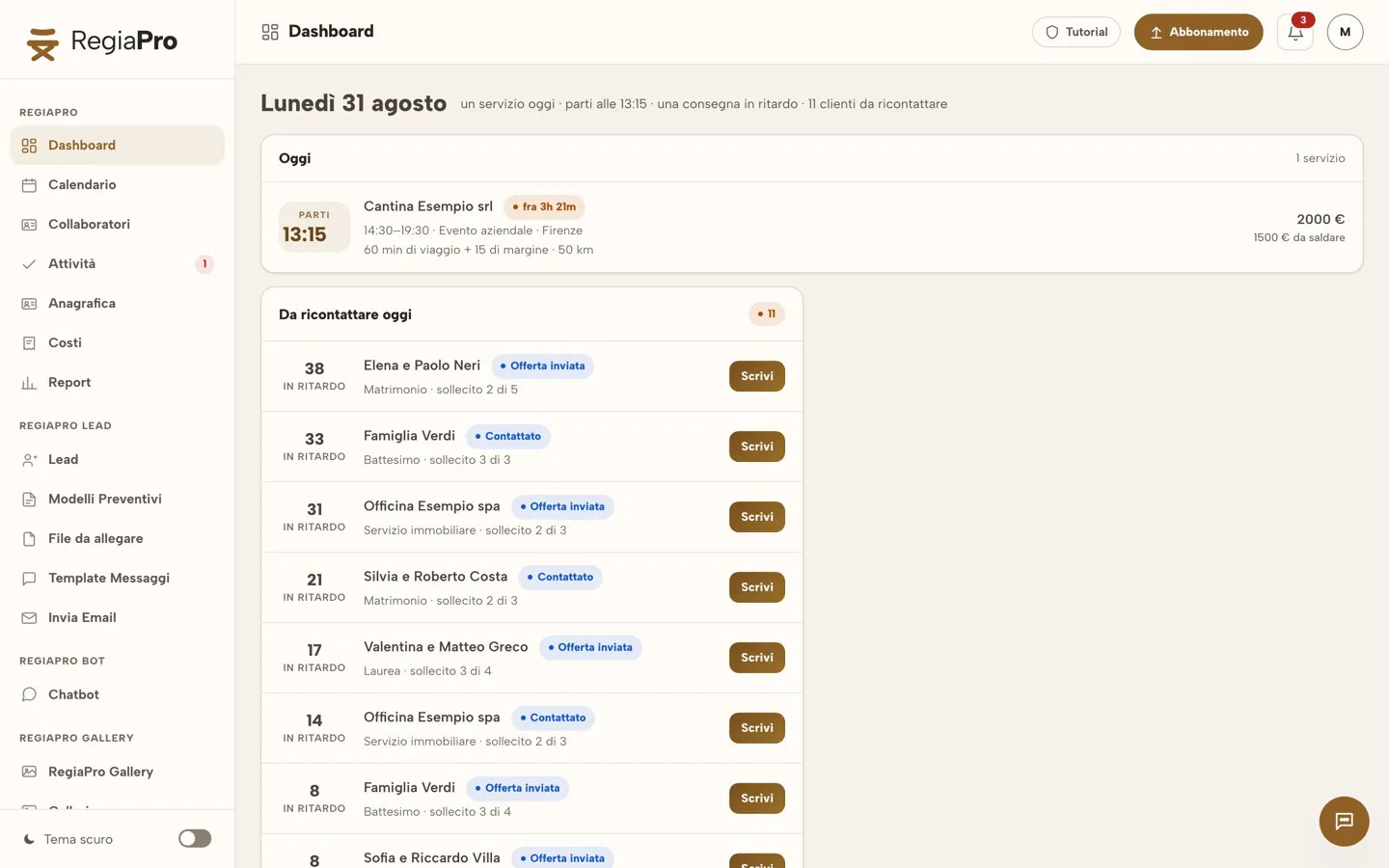
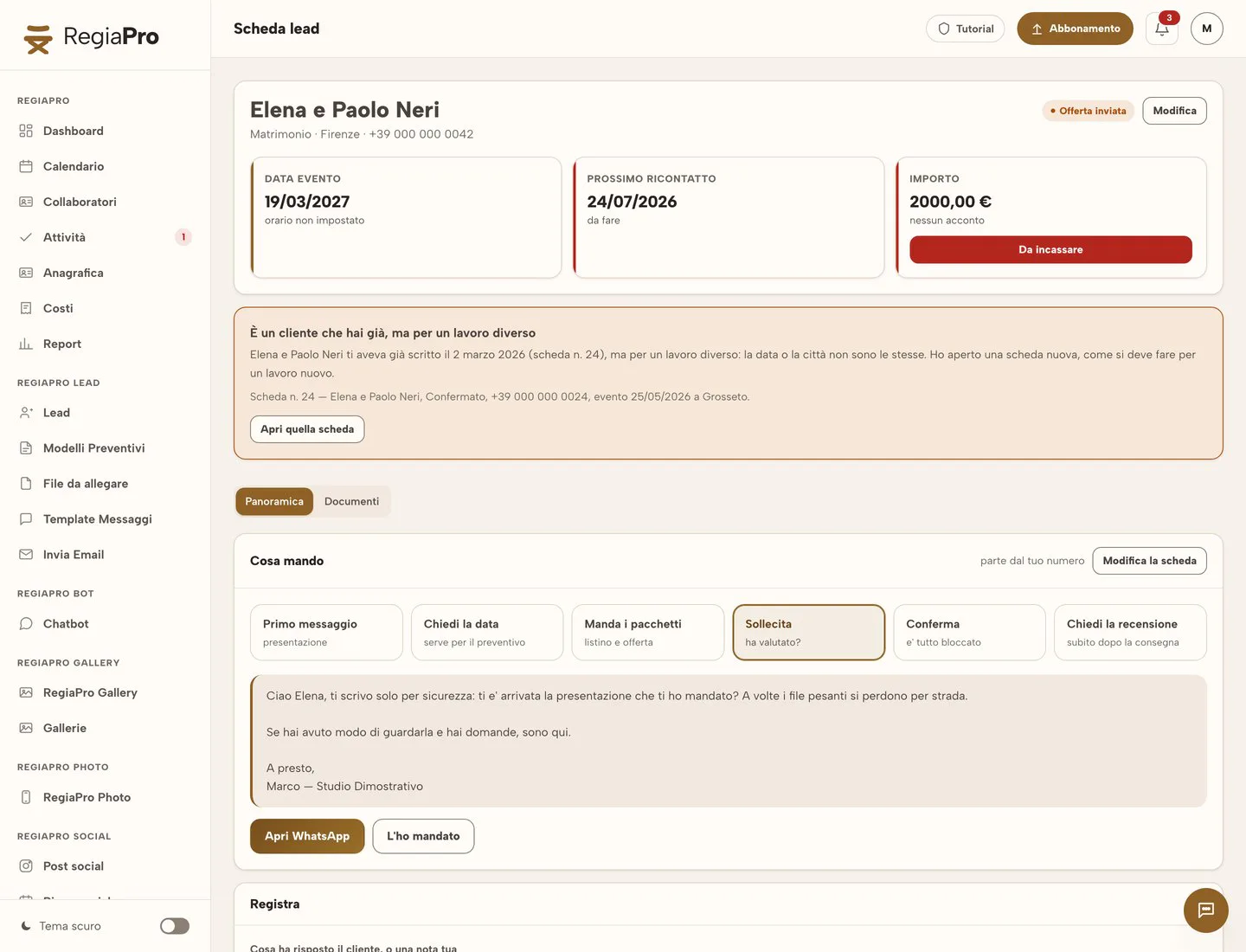
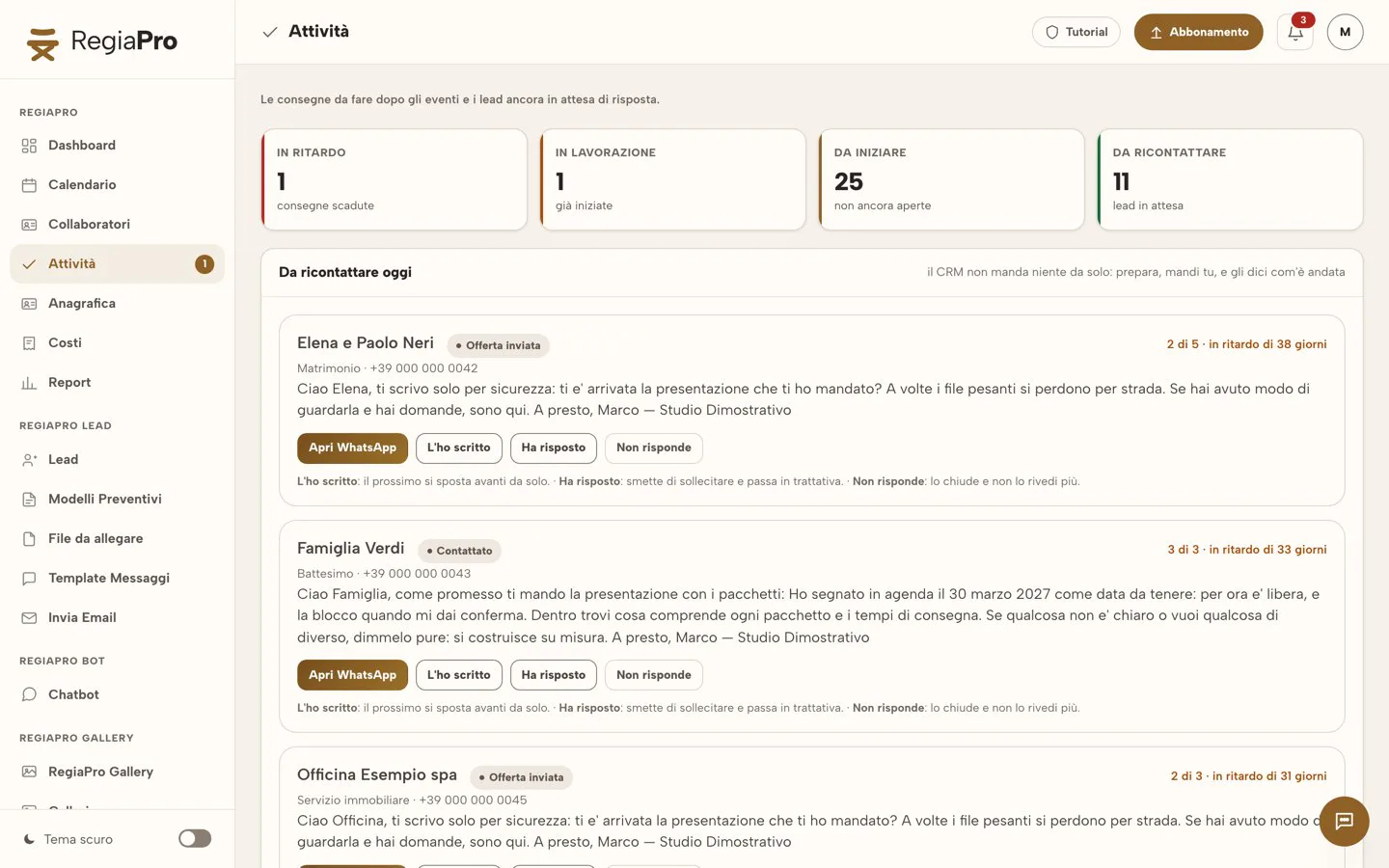
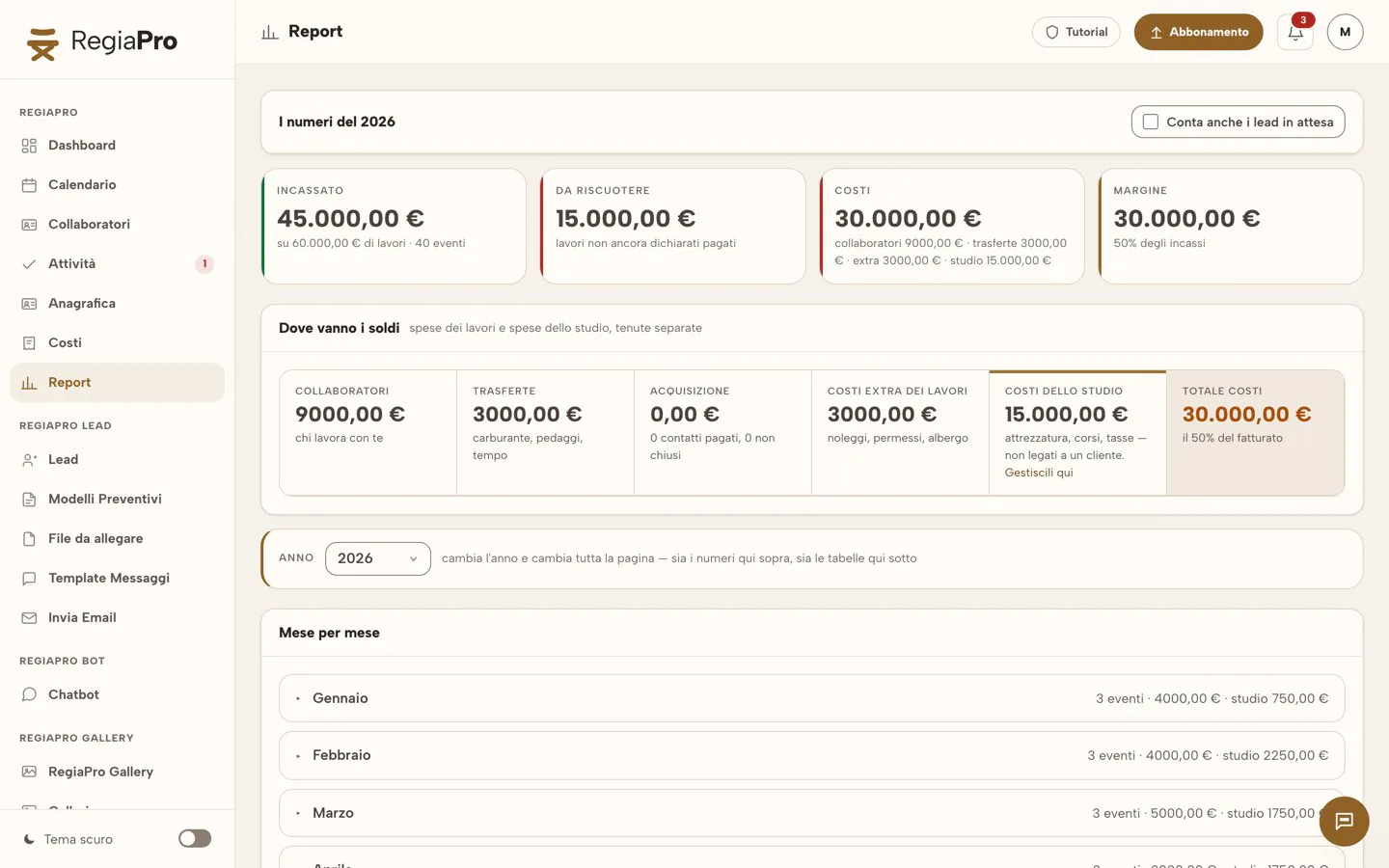
Business software for freelance developers and small software houses: who it’s for
RegiaPro is for self-employed developers building for third parties, and for small software houses where the same person prepares the estimate, talks to the client and ships the final version. Four kinds of project feel right at home in it.
Custom web apps and business systems
Months of work, an analysis to get signed off, interim releases and a client who only works out what they really need halfway through.
Mobile apps to publish on the app stores
Two platforms, app store review with its own timing, and a launch often tied to a date on the client’s side: a new branch opening, a season, a trade fair.
Integrations between e-commerce, stock and shipping
Connecting an online shop to the warehouse, a website form to a spreadsheet, a business system to a shipping service: short jobs, often at a fixed price.
Software support after release
Fixes, library updates, a new feature six months later: small requests that still need to be estimated, accepted and paid for.
The rest of a developer’s work, away from the code
For the technical side you already have your tools: repository, tickets, test environments. Everything else ends up scattered across email, chat and notes: which estimate the client accepted, who has been waiting two weeks for a reply, which instalment on the March project is still missing. RegiaPro is the place for that everything else: the CRM for people, the business software for documents and payments.
How a developer gets started with projects already open
Open a record for every project still open, with the date of the next release and how much you’ve already received. The next morning the home page lists who is waiting for your call, and confirmed releases are on the calendar. The comparison with other types of software comes further down.
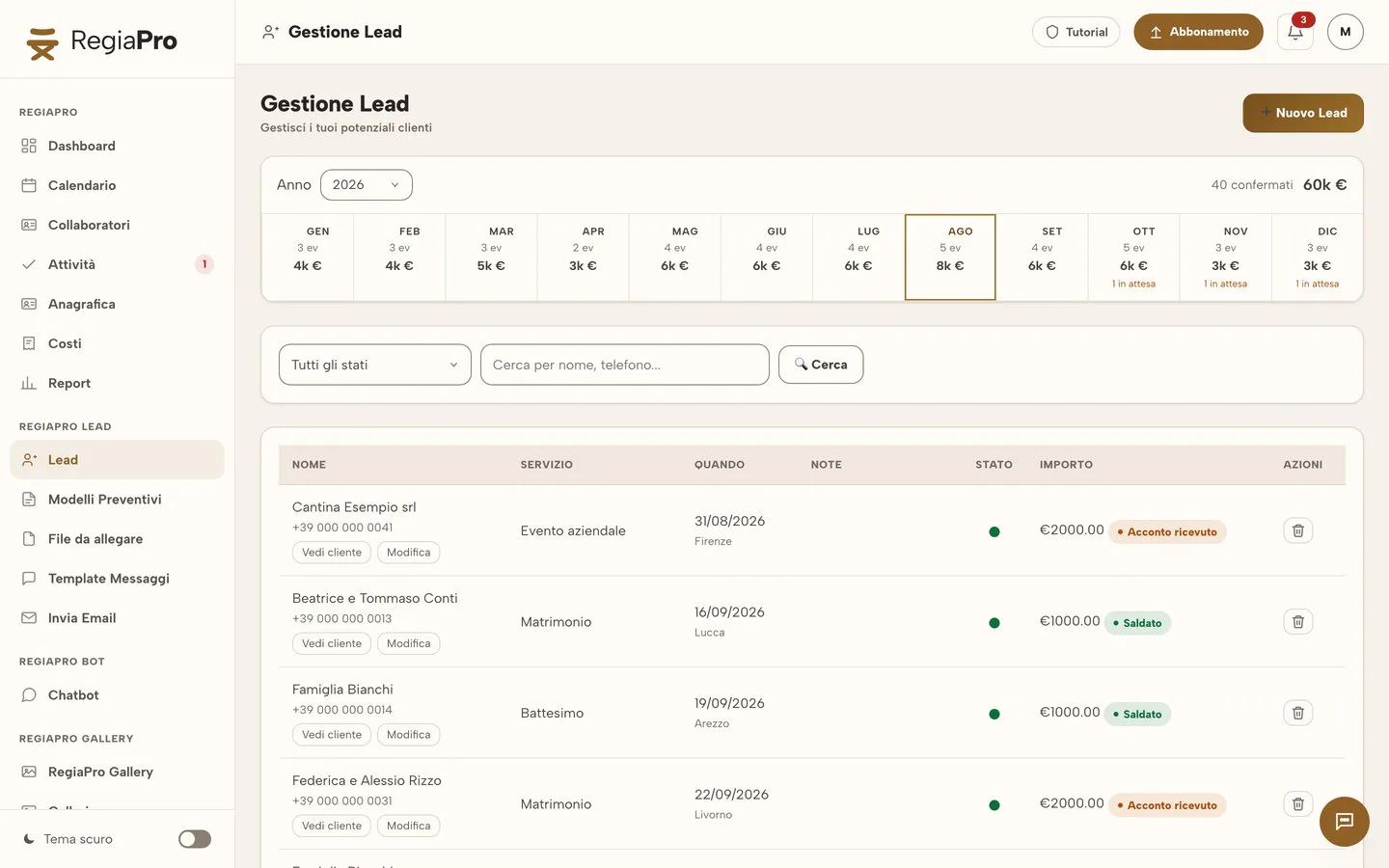
CRM for freelance programmers: every development enquiry in one record
The CRM side follows the people who ask you for software. Here are the six questions a freelance programmer asks most often during a negotiation, and where to find the answer inside RegiaPro.
“Who wrote to me about that integration?”
Enquiries come from a colleague who’s too busy, a Telegram group, LinkedIn, an old client. Every contact becomes a record with name, phone, email and source; you define the sources yourself, for example “colleague”, “LinkedIn”, “personal website”.
“Where did I save the analysis document?”
Specs, screenshots of the system being replaced, a sample export: you upload them to the client’s record. PDF, Word, ODT, JPG and PNG are all fine, up to 15 megabytes each.
“Has the client read the estimate?”
Once you send the estimate from the record, the client moves to “Quote sent” and RegiaPro puts them back among the people to contact after three days, then after a week, two weeks and a month. If they reply, you log it with the “They replied” button and the follow-ups stop.
“What did I promise them on the call?”
The record’s log lines up the emails sent with their attachments, the WhatsApp messages and the notes you write as soon as a video call ends. Three months later, the line “the admin panel was included” is there with its date.
“When does version 1.0 come out?”
A confirmed project puts the release date on Google Calendar or iCloud, with the time if you set one. If the client pushes it back and you move the event from your phone, with the calendar also linked for reading the record updates within a few minutes.
“How much did the icon design cost me?”
On the record you enter the freelance designer with her fee and, under extra costs, the services bought for that project. The “Report” takes them off the month’s takings.
Quote for app development: one project from analysis to release
A software development quote is easier to understand through a real case: we follow one project inside RegiaPro, split into three phases. The client is imaginary and the figures are only there to show how it works; every action described is in the software.
The client: two gyms and an app for classes
On 1 October Davide, who owns two gyms, contacts you on LinkedIn: he wants an app for members to book classes and for staff to check attendance. The new classes start in January, so the app must be downloadable from the stores by 12 January. It’s a typical freelance project: a client with no IT department, an estimate to build together, a deadline you don’t set.
-
App phase 1: analysis and estimate, in October
You create Davide’s record with LinkedIn as the source and 12 January as the date. After the call on 3 October you note what’s needed: class booking, waiting list, notifications, staff panel, two sites. You attach the screen layout as a PDF.
On 6 October you agree €9,600. You’re on Italy’s flat-rate scheme, so on the record you enter €9,600 and the estimate goes out without VAT. The PDF has a single line with the price, and you explain the calculation in the note printed at the bottom: analysis 16 hours, iOS and Android app 96 hours, web panel 40 hours, store publishing 8 hours, at €60 an hour, with three months of fixes included. You send it from the record.
On 8 October Davide wants to know how much he saves without the waiting list. You bring the amount down to €8,640 and generate a second estimate: new number, 23/2026-P, while 22/2026-P keeps the earlier figure. On 10 October he changes his mind and keeps the waiting list, so you set the record back to €9,600.
The quote from your template -
App phase 2: contract, deposit and development, October to December
On 13 October, from the Pro plan, you generate the contract from the template you called “Software development contract”. The clauses are yours: features included as per the estimate note, new requests estimated separately, source code handed over on final payment, three months of free fixes. Client, billing company with VAT number, release date and amounts go in by themselves. You sign it on paper at the gym.
On 15 October a €2,880 deposit arrives, 30%, by bank transfer: you record it and set the record to “Confirmed”, and 12 January appears on the calendar. In the important note you write “submit the app for store review”: RegiaPro turns it into a reminder for 5 January.
A freelance designer draws the icons and store images for €400: you add her as a collaborator. Under extra costs you note the store accounts, €124 in this example.
The contract, from the Pro plan -
App phase 3: stores, balance and invoice, in January
On 9 January the app is approved: from the record you open WhatsApp with a message prepared in advance and tell Davide he can download it. On 12 January the classes start with the app. The €6,720 balance comes in two instalments of €3,360, on 12 January and 12 February. Again from the Pro plan, you prepare the invoice for the whole project from the record: without VAT as the flat-rate scheme requires, with the €2 revenue stamp, which you can charge to the client.
Invoices and payments in the plans
The app project in numbers (example with invented figures)
| Item | Amount | Where to find it in RegiaPro |
|---|---|---|
| Agreed price | €9,600 | Record amount and estimate 22/2026-P |
| Deposit on 15 October | €2,880 | Deposit, with date and bank transfer |
| Instalment on 12 January | €3,360 | First balance instalment |
| Instalment on 12 February | €3,360 | Second balance instalment |
| Icons and images for the stores | €400 | Collaborator on the record |
| Store accounts | €124 | Extra costs |
| Difference, worked out by hand | €9,076 | The “Report” adds it to January, before tax and social security contributions |
Documents produced: two estimates, a contract, an invoice. The hours in the note help you and Davide read the figure; for payments and the “Report”, RegiaPro uses the agreed amount.
Software maintenance contract: post-release requests in the CRM
Once the app is live, the relationship with the client carries on. Here’s how a developer keeps support in order without mixing it up with the main project.
A contract template for software support
On the Templates page you prepare two contracts: one for development, one for the support that follows. In the second you set out duration, response times, jobs included and the rate for any extra.
A year of app support, one record
Annual support becomes a record with its own amount and expiry date. The important note “offer renewal” turns into a reminder a week beforehand.
The urgent bug on a Friday evening
An out-of-contract job goes in as a short record for the same client, with the figure agreed on the phone. Search their name at the end of the month and you find them all lined up.
The history when a code fix is in dispute
If the client insists a fix was included, the log shows you the emails sent to them, each with attachments, date and time, and the notes from the phone calls in those weeks.
Software development contract: the clauses to write before the code
A project without a contract soon becomes a project without an end. In RegiaPro you prepare the text on the Templates page, with whatever headings you like, and for each project the record’s details drop into the right places.
The scope of the features to build
Features included, platforms, integrations with other systems and what “done” means for both of you.
Change requests once development has started
How a new feature requested mid-project is estimated, approved and paid for.
Acceptance testing of the delivered software
How many days the client has to test the software and report defects before the release is considered accepted.
Source code, servers and store accounts
When the source code, server credentials and ownership of the store accounts pass to the client.
Amounts and release date in the development contract
Total, deposit, balance and release date come from the record through placeholders, so the signed sheet matches the numbers you’ll record.
Contracts are generated with the Pro plan and signed in pen. The copy produced stays attached to the project, with the wording of that day, even when you rewrite the template later on.
Want to see it with your own work?
Fourteen days with the Full plan features, no card needed. Then you decide.


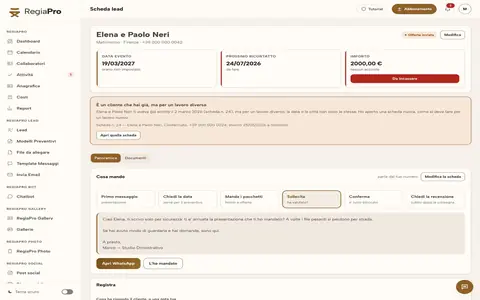
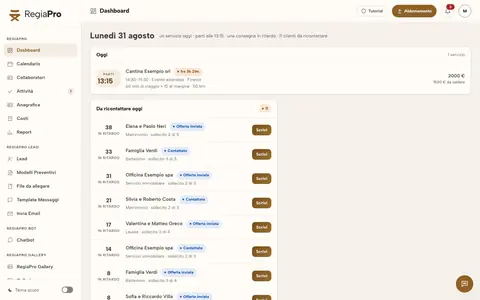



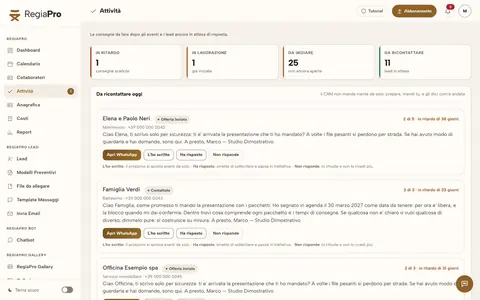
Free photos from Pexels and real screenshots of the software, with made-up data.
Programmer’s hourly rate: payments, costs and invoices in the business software
Whether you work by the hour or at a fixed price, the client gets a price. RegiaPro works from the agreed amount of each project and from that derives payments received and amounts outstanding, which the “Report” adds up month by month.
From hourly rate to project price
The hourly rate helps you build the figure: you write it in the estimate note together with the expected hours, and the record keeps the agreed total.
Self-employed programmer on the flat-rate scheme
Once the flat-rate scheme is set, estimates and invoices go out without VAT. When the untaxed amount exceeds €77.47, the €2 revenue stamp appears on the invoice; you add the scheme’s legal wording to the template with the dedicated placeholder.
Developer on the standard VAT scheme
With VAT, the record amount is the gross total: the software works out the taxable amount and the tax, and the figure promised to the client stays the same on the invoice too.
Invoices for development projects
From the Pro plan you prepare one invoice per project for the full amount, numbered in sequence, with the counter restarting from 1 every January. If you need to send the XML to Italy’s SdI system, you generate it with the Studio plan.
Where your development projects come from
You can link a cost per lead to each source, such as a listing on a freelance platform. In the “Report”, channel by channel, you read takings and costs and see which sources bring signed projects.
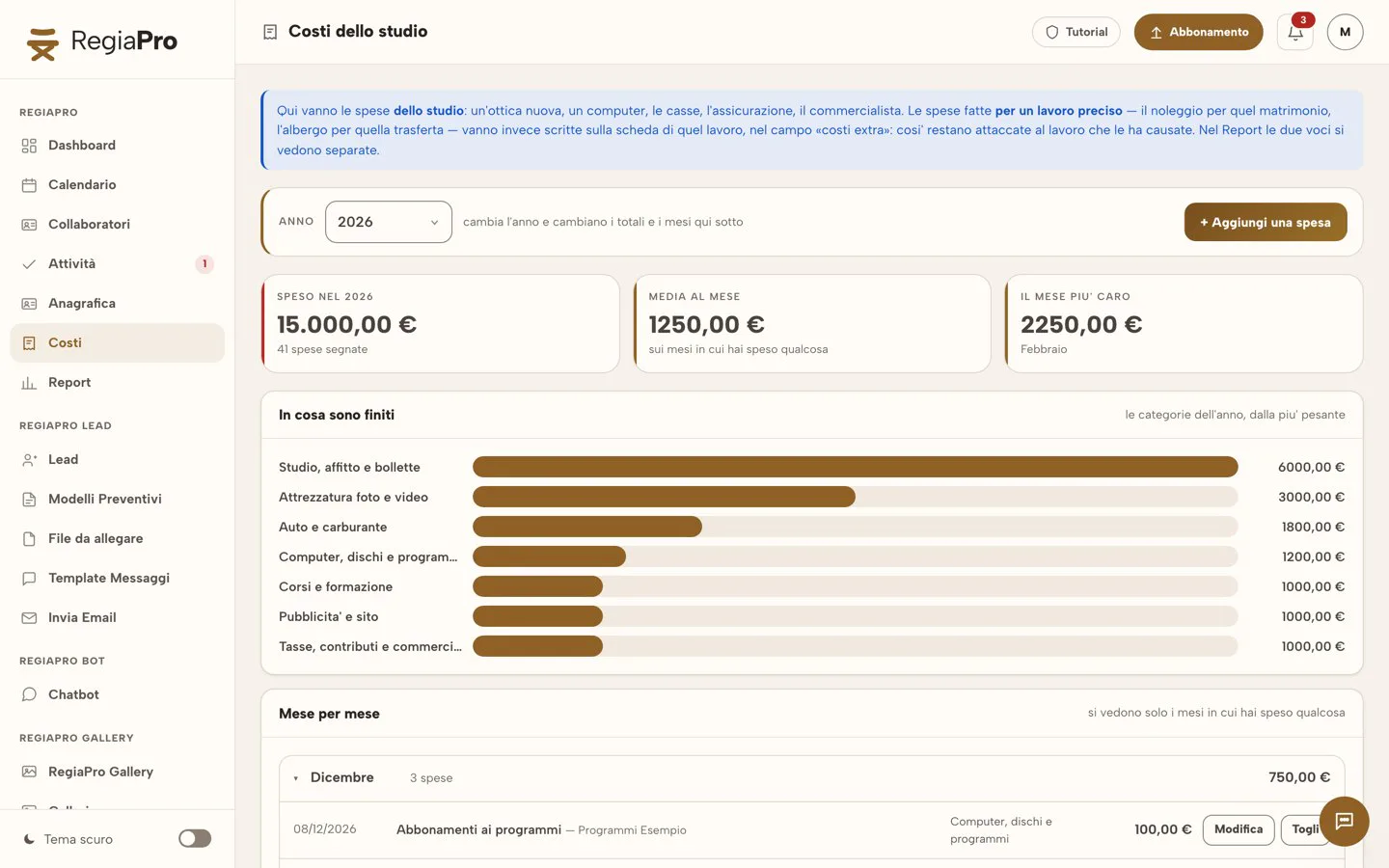
The image shows the Costs page with sample values: it gathers what you spend on the business as a whole, from the computer to subscriptions. What you pay for a single project, such as the store accounts, goes on that project’s record.
Software for freelance developers: CRM, invoicing or project management?
If you look for software to manage your clients, you mostly find guides to CRMs for freelancers and invoicing tools. In mid-September 2026 we read three of the top results: none explains how to write a development contract, none mentions deposits, and none is written for people who code.
| General sales CRMs | Invoicing software for the self-employed | RegiaPro, business software and CRM | |
|---|---|---|---|
| Designed for | Companies and salespeople with a deal pipeline | People who issue invoices and track tax deadlines | Freelancers who sell development projects on estimate |
| Strength | Pipeline, automations, integrations | E-invoicing, tax, online payments | Enquiries, follow-ups, PDF estimates, contracts, deposit and instalments, release dates |
| How to get started | Free plan, then paid | Free trial | 14 days on Full, then from €19.90 a month |
A developer gets on well with RegiaPro if
- your projects have an estimate, a deposit and a release date;
- you want to remember who’s waiting for a reply without building automations;
- you’d rather know the price before signing up.
What a programmer finds on day one
- client records with source, notes, attachments and log;
- numbered PDF estimates, contracts and invoices from Pro;
- deposit and instalments, calendar with Google or iCloud, editable WhatsApp texts.
How to start: three steps, no card needed
You sign up, try it on your real work, and only decide at the end.
-
Sign up in a minute
Your name, your business name and your email. We don’t ask for a credit card: access starts when you confirm your email.
Start the trial -
Set it up for your trade
Menus, record fields and job stages speak your language. You connect the calendar you already use.
Choose your trade here -
Try everything, then choose
Fourteen days with the Full features. At the end you choose a plan, or you stop: nothing renews on its own.
See the plans
What RegiaPro business software costs for freelance developers
All the prices below are published on the website. For people who develop to commission there are three plans to look at, and the trial comes first.
Start for those who take on a few projects: €19.90 a month
€199 on the annual subscription. Unlimited clients, follow-up reminders, WhatsApp messages and ten estimates a month: for those who take on a few projects and want to keep their negotiations in order.
Pro for development contracts and invoices: €34.90 a month
€349 a year. Adds development contracts, numbered invoices and estimates with no monthly cap, useful when several clients ask for a quote in the same week.
Studio for XML development invoices: €59.90 a month
€599 a year. Adds XML e-invoices and the annual summary for your accountant.
First, the trial on a development project
Two weeks with the complete Full plan and no card required. Access opens by itself as soon as you confirm your email.
The Full plan, €44.90 a month, is designed for those who deliver photos and videos to clients. The item-by-item breakdown is on the pricing page.
Why you can trust it: your data stays yours
What matters before you put your clients into a new program.
Your data stays in Europe
On servers in Europe. Each business sees only its own data: the database itself enforces the separation.
If you stop, your data stays yours
The account goes read-only and nothing is deleted unless you ask. We send you a copy in a readable format.
Prices written up front
A public price list, the same for every trade: you can read it on the pricing page before you sign up.
You talk to a person
Born in a studio in Tuscany, not in an office. Write to info@regiapro.it or use the contact page.
FAQ for people who code to commission
How do I explain hours, rate and included features in the estimate?
In the record’s amount field you enter the agreed price. In the estimate note you list features, expected hours and hourly rate: RegiaPro prints it under the price in the PDF, so the client understands where the figure comes from and you have the scope in black and white.
The client asks for a new feature mid-project: what do I do?
You update the amount and generate a new estimate from the same record: it gets a new number and the earlier ones stay archived as the client read them. If the feature is a separate job, you open a separate record for the same client, with its own date.
I’m on the flat-rate scheme: do estimates and invoices come out right?
Once you choose the flat-rate scheme in Settings, documents go out without VAT. On invoices over €77.47 before tax RegiaPro adds the €2 revenue stamp, charged to the client if you decide so. You insert the legal wording into the template with its placeholder.
I deal with the technical lead, but the company pays: who do I bill?
The record holds the name and contact details of the person you work with. The company name, VAT number and SDI code or certified email (PEC) are linked as the billing party: they appear on the contract and invoice, and stay ready for that client’s next project.
How do I split payment into deposit and instalments?
You record the deposit with date and method, then the balance in one or more instalments as they come in. The record shows what’s outstanding on that project; the home page adds up what you’re still owed by all your clients.
Where do I keep specs and analysis documents?
On the client’s record, once it’s saved: you upload PDF, Word, ODT, JPG or PNG up to 15 megabytes each. Next to them are the estimates generated and the log, so what you received and what you sent sit in one place.
The release slips by two weeks: what do I need to update?
Just one date. You can change it on the record, and the event on Google Calendar or iCloud moves; or move it in your phone’s calendar, and with reading switched on the record updates after a few minutes. The placeholders in later documents will use the new date.
How do I find a client from two years ago?
Type their name or phone number in the search: their records appear, each with estimates, contracts, invoices and log. From there you see what you charged last time and on what terms, before replying to the new enquiry.
Written and rechecked on 14 September 2026 against the software, feature by feature. Davide, the gyms and every project figure are examples made up for this page; what we say about other software we read on their websites at the time. Found a sentence your RegiaPro contradicts? Drop us a line at info@regiapro.it.
Try RegiaPro on your next development project
Next time someone asks you for an estimate, open the record in RegiaPro and take it through to the last instalment: it’s the most honest test of whether the software fits the way you work. For fourteen days Full is all yours, then you choose.
Related trades: web agency software, IT technician software, consultant software. The full list is on the Who it’s for page.